Yamma said:
Turin you talked about the Shariah, many people misunderstand the meaning or it, well actually believe an incorrect meaning. Shariah means the path to follow God’s Law. Shar’iah Law is holistic or eclectic in its approach to guide the individual in most daily matters. Shariah Law controls, rules and regulates all public and private behaviour. It has regulations for personal hygiene, diet, sexual conduct, and elements of child rearing. It also prescribes specific rules for prayers, fasting, giving to the poor, and many other religious matters. Civil Law and Common Law primarily focus on public behaviour, but both do regulate some private matters.
Ok, before I begin, I will say this. I will try my hardest not to offend anyone and if there are any Muslims here, please feel free to correct me. I am currently taking a course in Theology and Religious Philosophy, and my concentration is on the Indus Valley area and the Abrahamic Faiths. (This includes links to its predecessor, parts of the group of beliefs that calls itself the "Hindu" faith).
Shar'iah is derived from the route words in Arbabic meaning "Path Towards" or "Clear Road". If put in its religious context, it means a Path Towards [Heaven or God] or a Clear Road [set out by God]. The Islamic doctrine goes further than any of its predecessors, by providing an actual architecture for the government of a State of Islam. Christianity for example, relied heavily on the Old Testament to provide the laws (The Law = Torah), and made slight adjustments. This is a good point to discuss the difference.
Muslims believe in the following four revelations to have survived (not necessarily untarnished) from the 104 that have been revealed since "Adham" (which in Arabic coincidently means "Black" - i.e. the First man came from Africa).
Tawrath (Torah) - Zabur (Psalms) - Injil (Evangil) - Qur'an (Koran)
The phrases outside the the brackets are the Semetic terms for the books in question, and those whithin are common modern terms used. Out of the four, the Qur'an is the youngest, and the Torah is the oldest. The Tawrath is questionable in what the Qur'an defines it as, because it could either be the collective revelations of the Hebrews or the specific revelations made to Moses. Followed by the Zabur or Psalms inspired by the Rukh al-Quds (or the Holy Spirit*) to the Prophet David (Da'ud in Semetic languages). Now
the most questionable revelation is the Evangil.
One wonders what the Qur'an means by saying 'injil' or evangil, which is Greek for 'Gospel' which is Latin for Good News. The problem here is that the modern day bible contains around 64 books written by several appostles with references to the words of Isa (Jesus) the Christ (Messiah in Semetic languages). Even then there is a range of Bibles from the Gnostics to the King Jame's Version used in England. They have hugely different orders and some even have extra verses or chapters. It is commonly believed by Scholars, that the Injil refers to the original word of Jesus and therefore the current Evangils (Gospels) are simply reinterpretations. That is where you get the oft called Muslim saying: "Your Bible is Corrupt!", but they make it sound shallow, what they should say is: "Your Bible only retains references to the real Gospel (singular) and most the rest of it is interpetations through the eyes of other appostles".
The current Bible in the eyes of moderate Muslims is equatable to what they call the Hadiths. These are saying and actions of the Prophet recorded and passed on by witnesses. The problem here is that there is a system of credibility that the Hadiths work on; so when you read a Hadith you can expect to see:
"The Prophet once told me that drinking camel piss makes you healthy..." refered to by Ibn Aynas...
Now compare that to:
"And he pointed at the High Priest and said, He shall never entere paradise. Shocked the soldier turned and pondered. When the battle had drawn to a close, the Prophet walked among the death and offered prayers, but skipped the dead High Priest. He had a splint arrow in his thigh, and therefrom a bloody dagger in his hand which he had drawn across his throat in agony." witnessed by Ibn Abas, who told Al-Kaid, who authenticated with Ar-Haroon, who ... [etc, etc]
As you can see the difference here is that there are more witnesses and references to the Hadith in question making it more credibile at face value. Notice that I said at "face value", because that is very important. Scholars must also research the characters in question, for example, Ibn Aynas' false Hadith turned out to be one of several, and he was linked to a trechorous lifestyle against his Caliph, when it was unraveled that he was part of the Assasination. There can be a loose link in the chain which can make a whole Hadith useless.
This is equatable to the Gospels. If one Appostle says "blah de blah" and another says something totally opposite in the very same context, you know there is a problem and one of them got their information wrong. It also works with credibility. If John's writing went against Luke's for example, John would be awarded a higher merit because he was closer to Jesus and therefore most likely more accurate.
Alright, you probably have no idea where I am going with this ... so :
Basically when considering differences and similarities between people and their religion, its better not to take things at face value. These sort of things are so deep routed and that by insulting something like that you're sure to cause tumults.
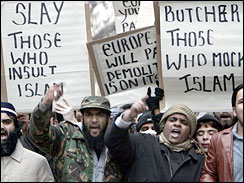
My bottom line: "The Press had all the rights in the world to create and publish those caricatures, whether they should have in a time of unrest, is another question. Morally this event was not viable, both the publication of deregatory satires and the backlash caused in the Muslim community - especially some of the vulgar comments on the boards in the protests. It was nothing but inciting racial hatred. Another thing is that the images should not have been given such wide publicity. What deregatory image of Christ or Buddha has ever been given such a wide publicity?"
Hey, hey, hey. Careful there. That's the ceremony of Ashurah on the 10th of Muharaam, celebrated by
some (2%) Shi'ah (10% of) Muslims. It is self flagelations (like when Priests flagelate themselves in time of war/famine/diesease). The schism is actually political and not religious, so I think the Shi'ahs are taking it a bit far. Even the Ayatollah Khomeini codemned the ritual (the highest Shi'ah leader) but tradition is so deep.
yes, what idiots
(carried out by the British extremists)
My point of this EDIT is that YOU cant judge an entire population of peoeple on a few people, when YOU yourself have probably done such bad, possibly even worse than some Muslims, BTW I'm talking about the unnecessary reactions of the Muslims
I agree, there was no needs to burn those buildings down, I mean, you could of sacked 'em and used it for a hospital or something! C'mon people be realistic :P
Turin